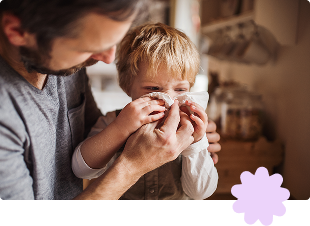
How to prevent the spread of flu?

Hygiene is important Hygiene is important

Hygiene is important in school and at home too. Be sure to1,2:

  1. Wash your hands regularly
  2. Cover mouth when coughing
  3. Throw away tissues after use
  4. Stay away from those who are unwell and stay at home if you feel sick1
  5. Clean surfaces regularly

Did you know?

Some studies have found flu germs can live up to 24 hours on hands and surfaces.3,4

Vaccination to help prevent flu

The nasal spray flu vaccine is part of the defence against flu as it can help prevent your child catching flu and spreading it to family, friends, and the rest of the community.5 Children can be offered a flu vaccine from their GP surgeries or school immunisation programmes depending on their age and the eligibility (who can receive it for free) guidelines decided by the government. The first-line, or the one you are most likely to be offered, flu vaccine in children and teenagers under 18 is the nasal spray flu vaccine; if the nasal spray is not suitable for your child, an alternative injectable flu vaccine may be offered.5

For more information on eligibility and further information, check with your school or healthcare team or visit the tab at the top for more information on eligibility and where to go.

Symptoms of flu in babies Symptoms of flu in babies

Symptoms of flu in babies, toddlers, children and teenagers

It can be pretty unpleasant for kids; ask someone who has had it, it is generally worse than a common cold.6,7 Click on the bars to see more details of the symptoms or signs of flu in different ages.

The symptoms or signs of flu usually appear quickly after infection and last for about a week.2,6 The signs of flu in babies and toddlers can differ from the signs of flu in older children; a baby or toddler may show their discomfort in different ways to older children.2

The common signs of flu in babies and toddlers include:2

  • A temperature of 37.5°C or above.
  • A cough.
  • Not taking their usual feeds.
  • Not having their usual wet or soiled nappies.
  • Sleeping more than usual.

When to seek further attention for your baby or toddler’s flu symptoms

If you think your baby or toddler has the flu and you are concerned, you can visit your GP, healthcare team or call 111 for advice. You might want to seek further attention if:2

  • A temperature of 38°C or more in babies under 3 months old, or 39°C or more in babies over 3 months old.
  • Fewer wet nappies, or nappies that seem drier than usual, or they have a dry nappy for more than 12 hours.
  • Difficulty feeding or is taking less than half their usual feeds over the last 2-3 feeds.

Symptoms in babies and toddlers that require emergency treatment

If you think your baby or toddler has the flu and you think there is an emergency, trust your instincts, and phone 999 or take them to A&E. Warning signs that your baby or toddler needs immediate medical attention include:2

  • They stop breathing, or have pauses in their breathing.
  • Have severe difficulty breathing or are breathing very quickly, even when resting.
  • Have skin that looks very pale, grey or white or has mottling on their arms, legs and body.
  • Have skin, lips and tongue that looks very pale blue or purple.
  • Isn’t awake, can’t be awakened, or is difficult to wake.

The flu, although mainly a respiratory illness (meaning from the nose, through the throat, and down into the lungs), can affect the whole body, and a child may experience a sudden onset of signs, including:2,4

  • A temperature of 38°C or above.
  • Body aches.
  • A cough.
  • Fatigue.
  • Runny or blocked nose.
  • Feeling or being sick.
  • Diarrhoea or tummy pain.

When to seek further attention for your young child’s flu symptoms

If your child has a high temperature for more than 5 days, or other flu symptoms don’t improve after 7 days, or if you are just worried about them, call your GP surgery or 111 for a medical opinion.4,8

Symptoms in young children that require emergency treatment

Seek emergency treatment and call 999 if your child:2

  • Stops breathing or experiences pauses in their breathing.
  • Has severe difficulty breathing (such as grunting or noisy breathing).
  • Appears seriously unwell (e.g., very pale, grey, or white, or has mottling on their arms, legs, or body).
  • Lacks normal colour in their skin, lips, and tongue (appearing very pale, blue, or purple).
  • Cannot be woken up or it is really difficult to wake them up, or they are breathing rapidly even when they are resting.

The flu, although mainly a respiratory illness (meaning from the nose, through the throat, and down into the lungs), can affect the whole body, and a child may experience a sudden onset of signs, including:2,4

  • A temperature of 38°C or above.
  • Body aches.
  • A cough.
  • Fatigue.
  • Runny or blocked nose.
  • Feeling or being sick.
  • Diarrhoea or tummy pain.

When to seek further attention for your child’s or teenager’s flu symptoms

If your child has a high temperature for more than 5 days, or other flu symptoms don’t improve after 7 days, or if you are just worried about them, call your GP surgery or 111 for a medical opinion.4,8

Symptoms in older children and teenagers that require emergency treatment

Seek out emergency treatment and call 999 if they have:4

  • Sudden chest pain.
  • Difficulty breathing.
  • Coughing up a lot of blood suddenly.

Treating flu at home Treating flu at home

Treating flu at home

There isn’t a specific treatment for flu in children, but there are some things that you can do to help them feel better; this can be giving them child-paracetamol or child-ibuprofen to help reduce fever, or encouraging them to drink plenty of water – it is important to stay hydrated during this time.2


If you need more support, ask your local pharmacist about over the counter remedies to help.

More information

Father holding and comforting toddler daughter who is ill Father holding and comforting toddler daughter who is ill

Want to learn more about flu?

Learn more about what flu is and how it spreads

Father looking after toddler son blowing nose Father looking after toddler son blowing nose

How serious is flu?

Learn more about how flu can have a serious impact to children

Head over to the FAQs for the most commonly asked questions surrounding flu and the nasal spray vaccine

  1. CDC. Healthy habits to protect against flu. Published August 26, 2021. Available at: https://www.cdc.gov/flu/prevent/actions-prevent-flu.htm. Accessed August 2024.
  2. NHS Inform. If your child has cold or flu symptoms. www.nhsinform.scot. Published December 5, 2022. Available at: https://www.nhsinform.scot/illnesses-and-conditions/lungs-and-airways/if-your-child-has-cold-or-flu-symptoms. Accessed August 2024.
  3. Greatorex J S. Et al. PLos One. 2011; 6 (11): e27932.
  4. NHS Choices. Flu. NHS. Published September 5, 2022. Available at: https://www.nhs.uk/conditions/flu/. Accessed August 2024.
  5. UKHSA. Flu vaccination programme 2024 to 2025: briefing for schools. GOV.UK. Published 2024. Available at: https://www.gov.uk/government/publications/flu-vaccination-in-schools/flu-vaccination-programme-2021-to-2022-briefing-for-schools. Accessed August 2024.
  6. Nidirect Government Services. Flu | nidirect. www.nidirect.gov.uk. Published October 19, 2017. Available at: https://www.nidirect.gov.uk/conditions/flu. Accessed August 2024.
  7. CDC. Cold Versus Flu. Centers for Disease Control and Prevention. Published 2019. Available at: https://www.cdc.gov/flu/symptoms/coldflu.htm. Accessed August 2024.
  8. NHS Choices. Fever in Children. NHS. Published 2020. Available at: https://www.nhs.uk/conditions/fever-in-children/. Accessed August 2024.

GB-68056 | August 2025